
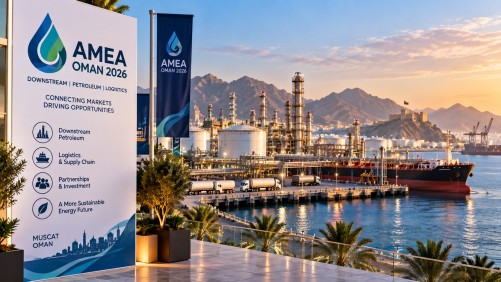
Amid evolving supply dynamics and escalating demand for adaptable logistics networks in the downstream petroleum markets of the Middle East, Asia, and Africa, Petrosil is set to host its seventh AMEA Bitumen, Base Oil, and Logistics Convention & Exhibition, dubbed AMEA Oman 2026. Scheduled for November 23, 2026, at the Radisson Collection Muscat, Hormuz Grand, this one-day event marks Petrosil’s inaugural industry gathering in Oman, following a successful track record of over 20 events in locations like Dubai, Bangkok, Mumbai, Abu Dhabi, and Bahrain since 2012. The convention aims to bring together a diverse array of industry players, including producers, refiners, traders, blenders, lubricant manufacturers, additive suppliers, wax producers, distributors, shipping companies, logistics providers, terminal operators, contractors, and industrial end-users.
Strategically positioned, Muscat offers pivotal maritime routes that link the Middle East with the Indian subcontinent, East Africa, and Asia. Oman’s burgeoning ports and logistics infrastructure further bolster its standing in regional trade. For downstream petroleum products, transportation logistics, encompassing freight rates, vessel availability, and terminal capacities, significantly influence costs. Recent disruptions to traditional shipping routes have heightened the focus on alternative corridors and supply chain robustness, with ports like Sohar and Duqm gaining prominence as key regional transshipment hubs.
Bitumen markets face a dynamic supply landscape, closely tied to infrastructure development, particularly in emerging economies. Factors such as refinery operations, crude oil availability, and international trade flows are pivotal. India exemplifies how regional supply can stabilize through increased local production and alternative crude sources, following disruptions in West Asian flows. Across the AMEA region, stakeholders are reassessing supply risks by exploring diverse origins, sourcing strategies, and transportation routes.
The convention will also delve into base oils, lubricants, additives, and waxes, which are critical components in various industrial applications. Changes in refinery economics and trade flows can impact sourcing and blending strategies for lubricant manufacturers. Waxes, used in a range of consumer and industrial products, depend on consistent quality and distribution efficiency. Given that these products stem from the broader petroleum value chain, shifts in crude availability and logistics can ripple across these markets.
Logistics is slated to be a focal point at the convention, emphasizing its role beyond a mere support function within the commodity markets. Factors such as vessel availability, freight costs, and storage capacity are crucial to the final economics of petroleum transactions. For international businesses, access to alternative ports and reliable logistics providers is integral to supply chain strategies. AMEA Oman 2026 will explore interconnected areas such as bitumen supply and demand, base oils and lubricants economics, additives formulation, and wax distribution, fostering a platform for new partnerships in the AMEA region.
Legal Disclaimer:
The information contained in this article has been provided by independent third-party contributors, clients, or content partners. We do not independently verify the accuracy, completeness, legality, ownership, licensing, or reliability of submitted content, including text, images, videos, trademarks, or other media materials. The submitting party is solely responsible for ensuring that all content, including images and media assets, complies with applicable copyright, trademark, licensing, and intellectual property laws. We disclaim liability for any unauthorized use of copyrighted or proprietary materials by third parties. If you believe that any content published on this platform infringes your intellectual property rights, kindly contact the author above for prompt review and resolution.