
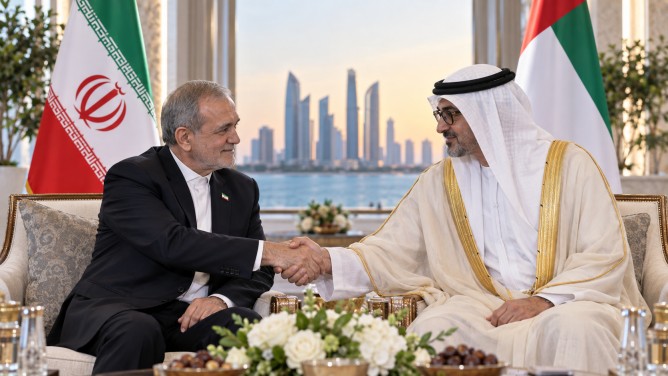
In a significant move towards mending regional ties, Iranian President Masoud Pezeshkian announced that Iran and the United Arab Emirates are eager to “turn the page” and forge a stronger relationship. This announcement follows heightened tensions across the region. The declaration came shortly after Pezeshkian’s meeting with Abu Dhabi Crown Prince Sheikh Khaled bin Mohamed bin Zayed Al Nahyan, which took place on the sidelines of the BRICS Summit in New Delhi. Both leaders described the discussion as constructive, emphasizing the importance of focusing on future cooperation.
This high-level engagement marks a pivotal moment in Iran-UAE relations, representing the most significant contact between the two nations since the conflict in West Asia escalated. Previously, these relations had been strained, with the UAE suspending trade and financial exchanges with Iran amid increasing regional tensions. However, the recent dialogue indicates a mutual desire to address and overcome past challenges, focusing on stability and development.
During their discussions, Pezeshkian and Sheikh Khaled addressed various regional and international developments, underscoring the need for de-escalation and the promotion of peace. The timing of their meeting coincided with a joint statement from Iran, the UAE, and other BRICS members advocating for restraint in the ongoing conflict, reflecting a shared commitment to fostering a more peaceful regional environment.
Despite international sanctions, the UAE, particularly Dubai, remains economically vital to Iran, serving as a major commercial hub for the Iranian community. This economic interdependence highlights the importance of maintaining robust bilateral ties. As Iran and the UAE seek to enhance their relationship, these economic connections may serve as a foundation for future collaboration and growth.
In a related development, US President Donald Trump expressed a lack of concern regarding a proposed meeting between Iran and Gulf states focusing on the Strait of Hormuz. This meeting, scheduled to occur in Oman, comes amid ongoing tensions between Washington and Tehran. The discussions aim to address critical regional issues and further emphasize the importance of dialogue in achieving lasting peace and stability.