
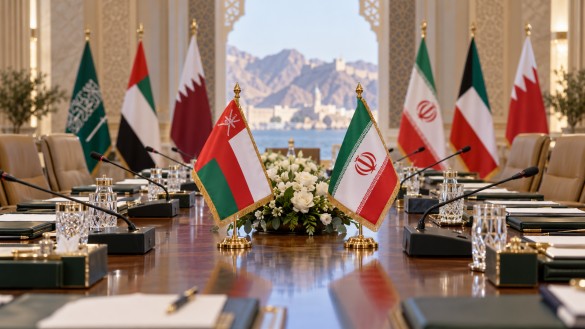
Oman’s Foreign Minister Badr Albusaidi has called for a regional security pact involving the six Gulf states, Iran, and Iraq, emphasizing the need for Middle Eastern countries to take charge of their security rather than relying on external powers like the United States. Speaking at Girton College, Cambridge, Albusaidi highlighted the exclusion of Iran from previous security arrangements as a factor that has fueled regional tensions and complicated dispute resolution.
Albusaidi proposed a non-aggression pact, urging dialogue and collective responsibility among the Gulf nations, Iran, and Iraq. He criticized the significant role that external powers have played in shaping regional security policies, which he believes has limited the ability of neighboring countries to find common ground.
His comments come amid ongoing discussions in Tehran between senior officials from Türkiye, Pakistan, and Saudi Arabia. These talks are focused on regional security and efforts to prevent renewed conflict between the United States and Iran, with an emphasis on future security arrangements in the Middle East.
The Omani minister underscored the strategic importance of the Strait of Hormuz, a vital conduit for global energy shipments, advocating for collaborative regional efforts to ensure maritime security and prevent further escalation. Albusaidi also noted that past negotiations between Washington and Tehran, facilitated by Oman, had shown promise, suggesting that a viable agreement had seemed within reach.
Despite Albusaidi’s calls for cooperation, the proposal for a regional security pact faces significant challenges. Longstanding mistrust, Iran’s military actions, and the security concerns of neighboring countries present substantial obstacles. Any potential agreement would require extensive negotiations and assurances from all involved parties.
In conclusion, Albusaidi’s proposal underscores Oman’s commitment to fostering diplomacy and regional cooperation as a means to alleviate tensions and establish a more autonomous framework for collective security in the Middle East.